
Generative AI explained properly — that’s what this post is here to do. You’ve heard the term in meetings, on LinkedIn, in the news — probably every day for the past two years. And if you’re being honest, you’re still not 100% sure what it actually means or why it matters to your work specifically. That’s not your fault. Most explanations either talk down to you or drown you in jargon. This one won’t.
In this post — I’m going to break down exactly what Generative AI is, how it works under the hood in plain English, and where it’s already changing how work gets done. By the end, you’ll have a clear mental model you can actually use.
Generative AI explained in 5 minutes — prefer to watch? Hit play above. Prefer to read? The full breakdown is below.
Generative AI Explained — What Actually Changed Around 2022?
For decades, computers only did exactly what you told them. You write the rules, they follow them — no exceptions, no flexibility. You show a computer 10,000 pictures of cats and it learns to recognise cats. Useful, but fundamentally limited.
Then something shifted. Suddenly you could describe what you wanted in plain English — and the computer just got it. No code. No rigid rules. Just results.
That shift has a name: Generative AI. And understanding what it actually is — not just the buzzword version — is what this entire post is about.
“The difference between traditional AI and Generative AI isn’t a software update. It’s a fundamental change in what computers can do.”
The Judge vs The Artist — the clearest way to understand it
The best mental model I’ve found for understanding this shift is what I call the Judge vs Artist analogy.
Traditional AI – The Judge
⚖️Classifies and labels existing data
✓Cat or not a cat?
✓Spam or not spam?
✓Fraud or legitimate?
Generative AI – The Artist
✦Creates brand-new content
✦Write me a cover letter
✦Generate an image
✦Compose a song
Traditional AI was reactive — it waited for input, then made a decision about that input. Generative AI is creative — it produces something new. That’s a fundamentally different capability, and it’s why the last two years have felt so different from everything that came before.
Think of it this way: a judge rules on evidence. An artist creates from nothing. Old AI was the judge. GenAI is the artist.
How does it actually work? The 3-step breakdown
This is the part most people skip — and honestly, it’s the most important part. Because once you understand how GenAI actually works, the whole thing becomes far less mysterious.
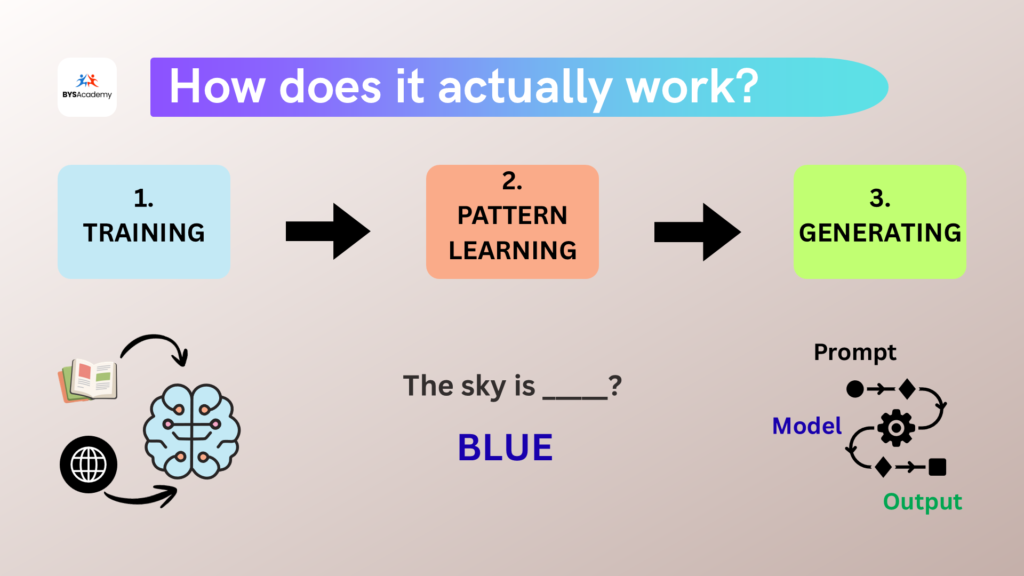
01. Training
The model reads massive amounts of text — books, articles, Wikipedia, websites, code. Not hundreds of documents. Not thousands. We’re talking billions of pages of human-written content. It gets exposed to an enormous chunk of human knowledge and language.
02. Pattern Learning
Here’s the key: it doesn’t memorise any of it. Instead, it learns patterns — what words tend to follow other words, what ideas connect to other ideas. Think of your phone’s autocomplete, but trained on everything humans have ever written instead of just your own texts. It learns the shape and flow of language itself.
03. Generation
When you give it a prompt, it uses those learned patterns to predict the most useful next word. Then the next. Then the next — until it’s built a complete, coherent response. It’s not retrieving a stored answer. It’s constructing a new one in real time, every single time.
“It’s not magic. It’s very sophisticated pattern completion — at a scale and speed humans simply can’t match.”
The autocomplete analogy is actually the most honest one. Your phone’s keyboard predicts one word at a time based on what you tend to type. A large language model predicts one word at a time based on what billions of humans have written. Same basic mechanism — vastly different scale and sophistication.
Where it’s already changing how work gets done
This is where it gets practical. Generative AI isn’t a future thing — it’s already inside the tools and workflows of millions of professionals right now. Here are six areas where the impact is already real:
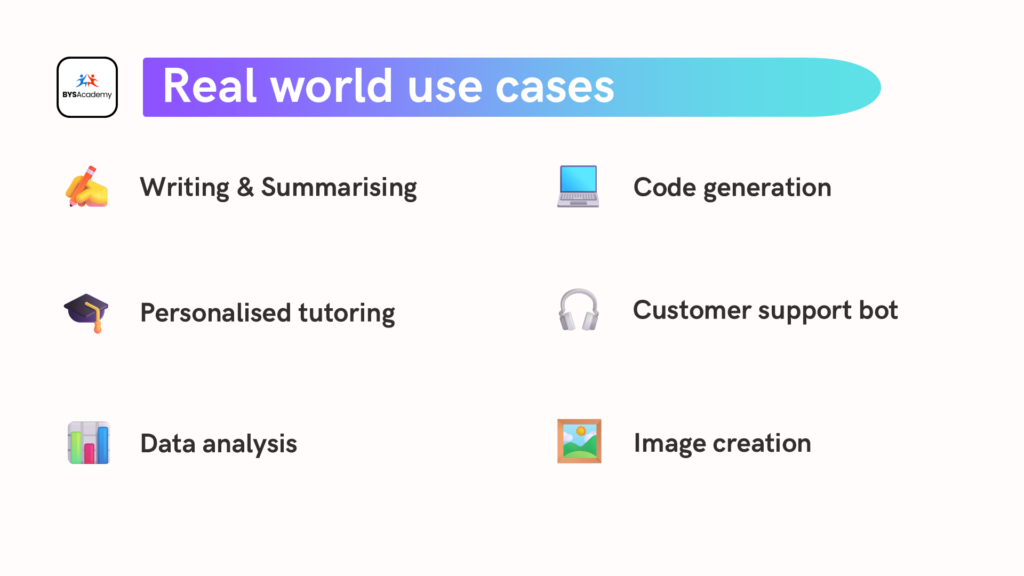
01. Writing & Editing
Draft emails, reports, and ad copy in seconds. First drafts in 30 seconds instead of 30 minutes.
02. Code generation
Developers auto-generate boilerplate code and spend their time on the hard, creative problems instead.
03. Image creation
Describe what you want in plain English and get a production-ready visual in minutes.
04. Customer support
Handle thousands of queries automatically, around the clock, without human intervention.
05. Data analysis
Describe what insight you need in plain English and get the SQL query or chart built for you.
06. Personalized Learning
Get any concept explained at exactly your level, with examples relevant to your specific situation.
The pattern is consistent across every one of these: GenAI handles the repetitive, time-consuming, first-draft work — so humans can focus on judgment, creativity, and the decisions that genuinely require a human perspective.
Before you go all-in — 3 limits you need to know
Here’s where I want to be honest with you, because most GenAI content glosses over this part. Generative AI has real limitations, and pretending otherwise will get you into trouble.
01. It can hallucinate
GenAI can confidently state things that are completely wrong. It doesn’t know what it doesn’t know — so it fills gaps with plausible-sounding information that may be inaccurate. Always verify anything important before acting on it.
02. It has no real-time knowledge
The model was trained on data up to a certain date. It genuinely doesn’t know what happened last week, last month, or anything after its training cutoff. Don’t rely on it for current events or recent data.
03. It needs good prompts
Vague input produces vague output. The quality of what you get back is directly tied to the clarity and specificity of what you put in. This is a skill — and one worth developing deliberately.
Think of Generative AI as a brilliant new employee on their first day. Incredibly capable, surprisingly fast, broadly knowledgeable — but you still need to check their work, give them clear instructions, and make the final call on anything important.
Published on April 25, 2026
Last updated on April 27, 2026