
AI Agent vs AI Workflow vs Automation: 4 Proven Patterns to Cut Enterprise Complexity
Last Updated on September 11, 2026
Table of Contents
Context
Not every enterprise challenge requires an autonomous system. As organizations shift from generative AI experimentation to production, understanding AI agent vs AI workflow vs automation has become the central architectural decision. Choosing the wrong pattern leads to inflated token costs, unnecessary latency, and unmanageable governance risks.
The architect’s objective is not to maximize autonomy, but to identify the minimum level of intelligence required to solve the problem reliably.
According to McKinsey’s State of AI data, 40% of large organizations report scaling AI agents. Yet, research from Deloitte highlights a stark operational gap: only 21% of enterprises report mature governance for agentic AI, and a mere 5% consider their core business processes prepared for agent deployment.
The critical architectural challenge today is not:
“Can AI do this?”
It is:
“What is the minimum level of intelligence, autonomy, and risk required to solve this problem reliably?”
In enterprise systems design, practical implementations fall into four distinct operational patterns:
- ⚙️ Traditional Automation (Deterministic logic & rules engines)
- 🔄 AI Workflow (Deterministic pipelines with probabilistic intelligence steps)
- 🤖 AI Agent (Dynamic, goal-oriented autonomy and adaptive execution)
- 👤 Human-in-the-Loop (HITL) (Assisted intelligence with non-negotiable human authority)
These patterns do not represent a maturity curve. An AI agent is not inherently superior to an AI workflow, nor is a workflow superior to deterministic code. Selecting the right pattern requires evaluating predictability, reasoning depth, operational reversibility, and total cost of ownership.

At a Glance: AI Agent vs AI Workflow vs Automation
When evaluating AI agent vs AI workflow vs automation, architects often make the mistake of treating them as a linear progression or maturity curve:
Automation -> AI Workflow -> AI AgentIn reality, these represent three distinct architectural patterns designed for different operational realities:
- Traditional Automation: Purely deterministic rules engines, cron triggers, and RPA for known inputs and predictable paths.
- AI Workflow: A deterministic pipeline (DAG) where AI performs bounded semantic tasks (like document extraction or classification) without controlling execution order.
- AI Agent: A goal-oriented, dynamic feedback loop where the model decides its own execution path, selects tools, and adapts based on interim observations.

The 7-Question Architectural Assessment
Before selecting an LLM framework or orchestration library, evaluate your use case against seven core parameters:

- Predictability: Can the logic be codified as boolean checks or mathematical formulas?
- Variability: Does every transaction follow the same lifecycle, or does the execution branch unpredictably?
- Reasoning Need: Is there unstructured language, complex document extraction, or semantic synthesis involved?
- Autonomy Mandate: Must the software dynamically choose its next tool and determine when the task is finished?
- Blast Radius / Risk: What is the financial, legal, or operational impact of a hallucinated output or invalid action?
- Reversibility: Can a completed operation be rolled back safely and automatically?
- Accountability: Who carries regulatory and compliance liability for the eventual outcome?
Traditional Automation: When Determinism Wins
First Principle: If deterministic code can solve a problem reliably, never introduce probabilistic models.
Ideal Operational Profile
Traditional automation (rules engines, event-driven microservices, scheduled jobs, ETL scripts) remains the most robust choice when:
- Inputs and schemas are strictly formatted (JSON, CSV, relational DBs).
- Business logic is governed by explicit thresholds or statutory compliance rules.
- Output consistency must be verified with zero tolerance for variance.
Concrete Example: Payment Routing
Consider an accounts payable service processing incoming bills:
- Amount < ₹1,00,000: Auto-approve.
- ₹1,00,000 to ₹10,00,000: Route to Department Manager.
- Amount > ₹10,00,000: Require VP Finance review.
- Unrecognized Vendor: Route to Procurement Fraud Desk.
Incoming Invoice ──► Validate Fields ──► Check Thresholds ──► Route/Approve
(Deterministic validation, zero LLM intervention needed)The Architectural Pitfall
Deploying an LLM agent to read structured invoice JSON and infer approval routing introduces:
- Non-deterministic edge cases and potential bypass vulnerabilities.
- Unnecessary latency (seconds vs. sub-millisecond execution).
- Escalated computing overhead and token consumption.
- Burdensome trace evaluation and regression testing.
AI Workflows: Intelligence Inside Bounded Rails
First Principle: The business process is known and fixed, but specific steps require semantic interpretation.
In an AI Workflow, deterministic software manages orchestration, state, and routing, while machine learning models or LLMs are invoked as modular components for unstructured tasks.
Core Capabilities Handled by AI Steps
- Multi-format document information extraction (OCR to structured JSON).
- Sentiment categorization and intent classification.
- Text summarization and context normalization.
- Domain-specific document retrieval (RAG).
[Input Document]
       │
       ▼
[AI Extraction & Entity Parsing] ──► [Schema Validation Gate]
                                              │
                                              ▼
[Deterministic Business Rules Engine] ──► [Final Action / Human Queue]Production Example: Claims Processing & Customer Triage
In enterprise insurance claims, an AI workflow ingests unstructured medical records, verifies policy eligibility via database queries, extracts line items, and surfaces high-value discrepancies to claim handlers.
Similarly, in high-volume customer service operations (such as Air India’s deployment of AI.g, which processes tens of thousands of customer queries daily across more than 1,300 categories), the AI classifies intent and fetches real-time booking details within tightly bounded flight-policy APIs, rather than having unrestricted authority to alter core reservation systems.

AI Agents: Dynamic Goal Pursuit & Tool Selection
First Principle: Deploy an agent when the execution sequence cannot be designed as a fixed graph in advance.
An AI Agent receives a target objective, queries its environment, reasons through partial findings, dynamically calls APIs or tools, and alters its plan based on intermediate observations.
Goal -> Reason -> Select Tool -> Observe State -> Refine Action -> ResolveLegitimate Enterprise Use Case: SRE Root-Cause Analysis
When an engineering team is paged for anomalous checkout latency:
- The agent inspects APM telemetry and detects thread pool starvation on a database node.
- It generates a hypothesis regarding a slow query lock or connection saturation.
- It selectively queries database logs and cross-references recent Canary releases from the CI/CD pipeline.
- It confirms the root cause: an unindexed database query introduced in the latest patch.
- It compiles an incident briefing and posts it directly to the response channel.
The agent’s value lies in its ability to navigate open-ended exploratory branches where a static script would break.
Decoupling Reasoning Autonomy from Action Authority
Architects must separate the ability to analyze from the permission to mutate:
- Reasoning Autonomy (Permissible): Inspect logs, run read-only diagnostics, summarize traces, draft potential remediation scripts.
- Execution Authority (Restricted): Rolling back deployments, altering production database configurations, modifying firewall rules.
Gartner’s research on agent governance emphasizes this principle: access control and authorization boundaries must be calibrated according to blast radius rather than assigning blanket permissions.
Human-in-the-Loop (HITL): Governing Irreversible Blast Radius
First Principle: Technical capability does not equate to organizational decision-making authority.
A model may demonstrate 98% accuracy on benchmark tasks, but that remaining 2% failure rate can represent untenable exposure in regulated environments.
                      [AI Analysis & Synthesis Engine]
                                   │
                                   ▼
             [Structured Evidence & Recommendation Dossier]
                                   │
                                   ▼
                ┌─────────────────────────────────────┐
                │ 👤 Human Review & Approval Boundary  │
                └──────────────────┬──────────────────┘
                                   │
                          Approved / Rejected
                                   │
                                   ▼
[System Execution / Commit]High-Stakes Decision Domains
Human oversight is mandatory when failures cause irreversible harm:
- Underwriting high-value commercial credit lines.
- Clinical diagnosis recommendations.
- Terminations, promotions, or regulatory compliance disclosures.
- Irrevocable database migrations or large financial disbursements.
Anti-Pattern: Approval Bottlenecks
Inserting human sign-offs for low-risk administrative outputs (e.g., draft email formatting, internal search summaries) defeats the operational efficiency of automation. Human checkpoints should exist exclusively where human judgment materially reduces organizational risk.
Anti-Patterns: When NOT to Build an AI Agent
Before allocating engineering resources to agent frameworks, verify that your use case does not fit these common anti-patterns:
- The Rules Already Exist: If business logic can be written as
if/thenconditions, do not replace it with an LLM. - The Execution Path Is Uniform: If 95% of requests follow identical steps, an orchestrated workflow is faster, cheaper, and more reliable.
- High-Frequency, Latency-Critical Tasks: Multi-step agent loops that take 10–30 seconds are unsuitable for real-time transactional paths.
- Irreversible Action Spaces: Never grant an autonomous agent direct write/delete access to core systems of record without deterministic validation gates.
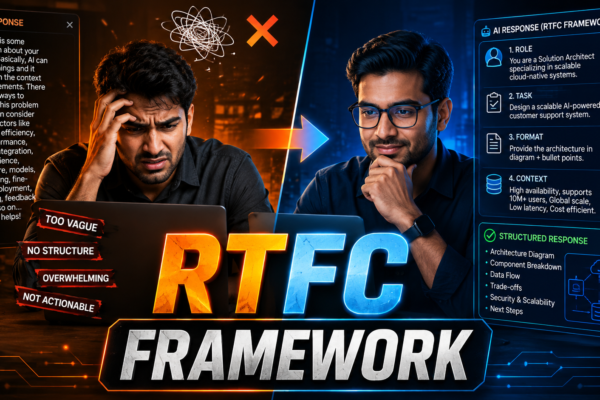
- Missing Telemetry & Context: An agent without high-quality context and comprehensive tool definitions will hallucinate actions faster. Structuring the prompts and context you feed an agent — as outlined in our RTFC prompt engineering framework — meaningfully reduces this risk.
- Absence of Observability Infrastructure: If you cannot capture step-level execution logs, tool call arguments, latency, and token expenditures, do not deploy agents to production.
AI Agent vs AI Workflow vs Automation: Practical Architectural Decision Framework

Frequently Asked Questions (FAQ)
What is the core difference between an AI workflow and an AI agent?
The fundamental difference lies in who controls the execution path. In an AI workflow, an external orchestrator enforces a predefined sequence of steps, using AI models for specific tasks like parsing or summarization. In an AI agent, the model itself assesses the current state, selects which tools to call, and determines subsequent actions dynamically.
Why not deploy AI agents across all automation tasks?
Agents introduce variable latency, non-deterministic outputs, higher operational costs per transaction, and complex failure modes. For structured, rule-bound processes, deterministic automation outperforms agents across reliability, auditability, and speed.
How does Human-in-the-Loop differ from simple manual intervention?
In a properly architected HITL pattern, AI performs context retrieval, anomaly detection, evidence synthesis, and initial drafting. The human reviewer is not performing repetitive data gathering, but evaluating a pre-compiled decision dossier at a critical governance checkpoint.
Summary: Rule of Thumb
When deciding on AI agent vs AI workflow vs automation, do not let industry hype dictate system architecture. The most resilient systems in production rarely use agents for everything. Instead, they use deterministic automation where rules exist, apply AI workflows where semantic parsing adds value, and deploy autonomous agents only where dynamic exploration is genuinely required.
- Traditional Automation: Optimize for cost, latency, and determinism.
- AI Workflows: Optimize for process consistency while parsing unstructured information.
- AI Agents: Optimize for flexibility in open-ended, complex problem-solving.
- HITL (Human In-The Loop) Integration: Optimize for accountability, compliance, and risk mitigation.