12 Key Features of Java: From JVM Core to Modern Java 21
Last Updated on September 22, 2026
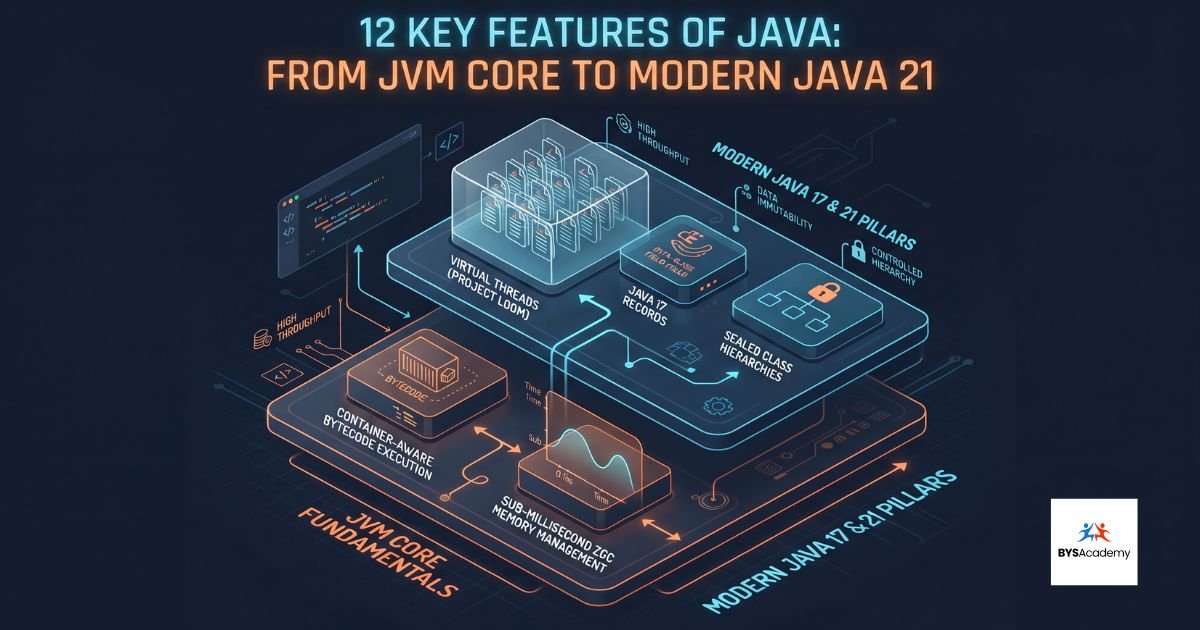
Java powers over 70% of enterprise backends worldwide, remaining the bedrock of financial systems and distributed cloud microservices. To build modern, scalable systems, developers must look beyond legacy syntax and master the 12 key features of java, spanning core JVM architecture to modern Long-Term Support (LTS) releases like Java 17 and Java 21.
With the release of modern Long-Term Support (LTS) versions—specifically Java 17 and Java 21—the Java Virtual Machine (JVM) has evolved into a modern, cloud-native runtime capable of lightweight concurrency, expressive functional syntax, and ultra-low-latency memory management.
Whether you are designing enterprise distributed systems on our Software Architecture Roadmap or architecting resilient microservices, understanding these 12 key features of Java is essential for writing clean, performant, and scalable code.
Table of Contents
Platform Independence via Modern JVM Bytecode & Container Awareness
Java’s original promise of “Write Once, Run Anywhere” (WORA) remains intact, but its modern implementation has matured significantly. Source code compiles into standardized intermediate bytecode executed by the Java Virtual Machine (JVM).
In cloud-native environments, modern JVMs (Java 11+) are fully container-aware:
- The JVM automatically detects Linux cgroups CPU quotas and container memory limits, dynamically adjusting heap allocations without manual
-Xmxguesswork. - Advanced Ahead-of-Time (AOT) compilation tools like GraalVM Native Image compile Java directly into standalone machine binaries, reducing cold-start times to milliseconds for serverless and Kubernetes deployments.
Multi-Paradigm Synergy: Object-Oriented Meets Functional Programming
Java has successfully unified classical Object-Oriented Programming (OOP) with declarative Functional Programming (FP).
Rather than forcing developers into pure paradigms, modern Java combines:
- Encapsulated OOP: Rigid domain boundary management, interfaces, and polymorphism.
- Declarative FP: First-class functions, pure functions, and immutable transformations introduced via lambda expressions and functional interfaces.
To master how functional programming transformed the language, explore our dedicated breakdown of Java 8 Features with Real-World Examples.
High-Throughput Declarative Pipelines: The Streams API
Introduced to eliminate error-prone imperative loops, the Streams API enables developers to process collections declaratively. Streams support operations like filtering, mapping, reducing, and sorting, leveraging lazy evaluation to execute complex data pipelines in a single traversal.
// Declarative filtering and data transformation
List<String> activeUserEmails = users.stream()
    .filter(User::isActive)
    .filter(u -> u.getAccountBalance() > 1000)
    .map(User::getEmail)
    .sorted()
.toList(); // Modern Java 16+ terminal collectionFor hands-on coding patterns and performance trade-offs, study our tutorial on Java 8 Streams API with Practical Examples.
Lightweight Concurrency: Virtual Threads (Java 21 / Project Loom)
Historically, Java concurrency followed a 1:1 model: every java.lang.Thread mapped directly to an operating system (OS) thread. Because OS threads carry significant memory overhead (~1 MB stack) and costly context switches, enterprise applications were forced to rely on reactive frameworks (WebFlux, RxJava) to handle high concurrency.
Java 21 changes this fundamentally with Virtual Threads:
- Virtual threads are lightweight, JVM-managed threads with minimal stack overhead (bytes, not megabytes).
- The JVM schedules millions of virtual threads onto a small pool of OS carrier threads.
- When a virtual thread executes a blocking I/O operation (database query, network call), the JVM unmounts it from the carrier thread, allowing other virtual threads to execute.
// Launching 10,000 concurrent tasks effortlessly in Java 21
try (var executor = Executors.newVirtualThreadPerTaskExecutor()) {
    IntStream.range(0, 10_000).forEach(i -> {
        executor.submit(() -> {
            Thread.sleep(Duration.ofSeconds(1)); // Non-blocking to the OS thread
            return "Task " + i + " completed";
        });
    });
} // Automatically awaits completion via AutoCloseableConcise Immutable Data Modeling: Records (Java 16/17)
For years, Java developers relied on Lombok or IDE generation to avoid writing hundreds of lines of getters, setters, equals(), hashCode(), and toString() methods for Data Transfer Objects (DTOs).
Java Records provide a first-class language mechanism for transparent, immutable data carriers:
// A complete, immutable enterprise DTO with built-in validation
public record OrderRequest(
    String orderId,
    BigDecimal amount,
    List<String> itemCodes
) {
    // Compact constructor for defensive validation
    public OrderRequest {
        Objects.requireNonNull(orderId, "OrderId cannot be null");
        if (amount.compareTo(BigDecimal.ZERO) <= 0) {
            throw new IllegalArgumentException("Amount must be positive");
        }
        itemCodes = List.copyOf(itemCodes); // Defensive immutability
    }
}Exhaustive Domain Boundaries: Sealed Classes (Java 17)
In enterprise architecture, domain models must often restrict inheritance to prevent arbitrary subclassing across external modules. Sealed classes and interfaces provide explicit control over which classes can extend or implement them:
// Defining a strict domain hierarchy for payment processing
public sealed interface PaymentMethod
    permits CreditCardPayment, UPIPayment, BankTransferPayment {}

public final class CreditCardPayment implements PaymentMethod { /* ... */ }
public final class UPIPayment implements PaymentMethod { /* ... */ }
public final class BankTransferPayment implements PaymentMethod { /* ... */ }Type-Safe Inspection: Pattern Matching for switch (Java 21)
Combining Sealed Classes with Java 21’s Pattern Matching for switch transforms complex conditional trees into clean, type-safe, exhaustive expressions without explicit casting:
// Exhaustive pattern matching without requiring a default branch
public String processPayment(PaymentMethod payment) {
    return switch (payment) {
        case CreditCardPayment cc -> "Processing credit card ending in " + cc.lastFourDigits();
        case UPIPayment upi       -> "Initiating UPI transaction for VPA: " + upi.vpa();
        case BankTransferPayment bt -> "Executing wire transfer to account: " + bt.accountNumber();
    };
}Low-Latency Garbage Collection: G1, ZGC, and Generational ZGC
Automatic memory management has always been one of Java’s greatest strengths, but stop-the-world (STW) pauses historically caused latency spikes in distributed systems. Modern JVMs feature production-grade collectors designed for distinct workloads:
- Generational ZGC (Java 21): Extends ZGC by separating objects into young and old generations, boosting throughput while maintaining sub-millisecond pause times.
- Garbage-First (G1) GC: The default general-purpose collector, balancing throughput and latency across multi-gigabyte heaps.
- Z Garbage Collector (ZGC): A scalable, low-latency collector where pause times never exceed 1 millisecond, regardless of whether the heap is 16 MB or 16 TB.
Modular Architecture: The Java Platform Module System (JPMS)
Introduced in Java 9 (Project Jigsaw), JPMS allows enterprise software teams to encapsulate internal packages and declare explicit module boundaries using module-info.java.
module com.bysacademy.orderservice {
    requires java.sql;
    requires com.fasterxml.jackson.databind;
    exports com.bysacademy.orderservice.api;
}Robust Concurrency Utilities & Asynchronous Orchestration
Beyond virtual threads, Java provides a battle-tested concurrency toolkit in java.util.concurrent:
- Non-Blocking Futures:
CompletableFutureallows developers to chain asynchronous computations, handle timeouts, and combine parallel asynchronous calls without nested callback pyramids. - Atomic Primitives & Thread-Safe Collections: High-performance lock-free data structures (
AtomicInteger,ConcurrentHashMap,CopyOnWriteArrayList).
Built-in Security Architecture & Robust Exception Handling
Enterprise Java provides layered security primitives:
- Structured Exception Hierarchy: Enforces separation between checked exceptions (recoverable business conditions) and unchecked runtime exceptions (programming defects and fatal failures).
- Strong Type Checking & Memory Safety: Pointer arithmetic is impossible, preventing buffer overflow vulnerabilities common in low-level languages.
- Modern Cryptography & TLS 1.3: Built-in cryptographic providers in
javax.cryptoreceive continuous security baseline patches across all LTS versions.
Production Observability: JDK Flight Recorder (JFR) & JMC
Monitoring enterprise production systems requires deep runtime insight with minimal performance overhead.
- JDK Mission Control (JMC): A graphical analysis suite that ingests JFR recordings to diagnose production memory leaks and thread contention without attaching invasive external profilers.
- JDK Flight Recorder (JFR): An internal event-tracing framework built directly into the JVM kernel, collecting execution metrics, thread locks, memory allocations, and I/O bottlenecks with less than 1% CPU overhead.
Comparison Matrix: Java Evolution Across Key LTS Releases
| Feature Dimension | Java 8 (Legacy Baseline) | Java 17 (Modern Enterprise Standard) | Java 21 (Current Long-Term Support) |
|---|---|---|---|
| Concurrency Model | Platform Threads (OS 1:1) | Platform Threads & Thread Pools | Virtual Threads (Project Loom) |
| Data Modeling | Verbose POJOs / Lombok | Records & Sealed Classes | Records with Record Patterns |
| Switch Syntax | Primitive / String Matching | Switch Expressions (Yield) | Pattern Matching for Switch |
| Memory / GC | Parallel GC / CMS (Deprecated) | G1 GC & Early ZGC | Generational ZGC (<1ms pauses) |
| Collection Utilities | Imperative / Streams API | .toList() on Stream pipelines | Sequenced Collections (getFirst, etc.) |
| Container Awareness | Basic / Requires Flags | Fully Cgroup v2 Integrated | Optimized for Kubernetes Pods |
To optimize how these applications compile, package, and deploy across enterprise CI/CD pipelines, read our comparative guide on Gradle vs Maven: The Ultimate Build Automation Comparison.
Summary: Modernizing Your Java Architecture Mindset
Java has long outgrown its reputation as a verbose, purely object-oriented legacy language. As explored in this roadmap, mastering the 12 key features of java—from container-aware JVM memory heuristics and sub-millisecond ZGC garbage collection to Java 21 Virtual Threads and Records—is what separates code implementers from enterprise software architects.
Modern LTS releases (Java 17 and Java 21) provide the primitives needed to build lightweight, high-throughput cloud microservices without relying on invasive external frameworks. As you design your next backend service, evaluate your systems not just on clean syntax, but on non-functional requirements: memory footprints, thread lifecycle costs, and long-term architectural maintainability.
Frequently Asked Questions
Which Java version should enterprise projects adopt in 2026?
Enterprises should target Java 17 or Java 21. Both are active Long-Term Support (LTS) releases. Java 17 serves as the baseline for modern frameworks like Spring Boot 3, while Java 21 introduces Virtual Threads and Generational ZGC for high-throughput concurrency.
How do Virtual Threads differ from Reactive Programming (WebFlux)?
Reactive programming uses non-blocking callbacks to handle high concurrency with few threads, but introduces steep debugging complexity and fragmented stack traces. Virtual Threads provide the same scalability benefits while preserving simple, synchronous, imperative coding and debugging patterns.
Is Java still relevant for cloud microservices?
Yes. With container-aware memory heuristics, GraalVM native binary compilation, sub-millisecond ZGC garbage collection, and Virtual Threads, modern Java delivers cloud startup times and memory footprints comparable to Go and Rust while retaining enterprise library support.
How have the 12 key features of Java evolved in Java 21?
While traditional features focused on object-oriented structures and manual memory management, modern Java 21 introduces lightweight concurrency with Virtual Threads (Project Loom), Generational ZGC with sub-millisecond pauses, and pattern matching for switch, significantly reducing cloud infrastructure costs.
Are Java Records better than Project Lombok for domain models?
Yes, for immutable data carriers. Java Records provide transparent, native compiler-level immutability without requiring third-party bytecode manipulation or IDE plugins, making serialization and runtime reflection safer.