Java 8 Features with Examples: Real-World Guide to Java 21
Last Updated on September 22, 2026
Released in 2014, Java 8 was the single most transformative release in the language’s history. To design clean, functional code and prepare for technical interviews, understanding these foundational java 8 features with examples is essential for any engineer working on enterprise backends or planning migrations to Java 17 and 21 LTS.
Even today, Java 8 remains a major search topic for interview preparation and legacy system maintenance. However, modern senior developers and architects must understand both how Java 8 features work and how they have evolved into modern Java 17 and Java 21 LTS standards.
This guide covers the core features of Java 8 through practical, production-ready code examples, complete with architectural commentary on how each feature connects to our Software Architecture Roadmap.
Lambda Expressions: Writing Expressive, Boilerplate-Free Code
Before Java 8, passing behavior to a method required instantiating verbose Anonymous Inner Classes. Lambda expressions allow developers to treat functions as method arguments, passing executable code cleanly and expressively.
// Pre-Java 8: Verbose Anonymous Inner Class
Runnable legacyRunner = new Runnable() {
    @Override
    public void run() {
        System.out.println("Executing task in legacy thread");
    }
};

// Modern Java 8+: Compact Lambda Expression
Runnable modernRunner = () -> System.out.println("Executing task cleanly via Lambda");Real-World Business Example: Custom Sorting
List<Employee> employees = getEmployeeList();

// Sorting employees by salary descending using a Lambda
employees.sort((e1, e2) -> Double.compare(e2.getSalary(), e1.getSalary()));

// Or cleaner still, using modern Comparator syntax:
employees.sort(Comparator.comparingDouble(Employee::getSalary).reversed());Functional Interfaces & @FunctionalInterface
A Functional Interface is an interface that contains exactly one abstract method (Single Abstract Method or SAM). Java 8 introduced the @FunctionalInterface annotation to enforce this condition at compile time.
Java 8 introduced four core functional interfaces in the java.util.function package:
| Functional Interface | Method Signature | Purpose | Real-World Enterprise Use Case |
|---|---|---|---|
| Predicate<T> | boolean test(T t) | Evaluates a condition on an object. | Filtering valid transactions or active user accounts. |
| Function<T, R> | R apply(T t) | Transforms input of type T into output of type R. | Mapping an entity domain model to a DTO. |
| Consumer<T> | void accept(T t) | Consumes an object without returning a result. | Logging audit events or sending email alerts. |
| Supplier<T> | T get() | Generates or supplies an object without input. | Lazy initialization or generating unique UUIDs. |
// Enterprise implementation of the 4 core functional interfaces
Predicate<Order> isHighValue = order -> order.getAmount() > 10_000.0;
Function<Order, String> extractId = Order::getOrderId;
Consumer<String> auditLogger = id -> System.out.println("Audit: High-value order processed: " + id);
Supplier<String> traceIdGenerator = () -> UUID.randomUUID().toString();

if (isHighValue.test(currentOrder)) {
    auditLogger.accept(extractId.apply(currentOrder));
}Method References: Syntactic Elegance (::)
Method references serve as compact, readable shorthand for lambda expressions that simply call an existing method.
Java 8 supports four types of method references:
- Constructor Reference:
ClassName::new(e.g.,ArrayList::new) - Static Method:
ContainingClass::staticMethodName(e.g.,String::valueOf) - Instance Method of a Particular Object:
containingObject::instanceMethodName(e.g.,System.out::println) - Instance Method of an Arbitrary Object of a Type:
ContainingType::methodName(e.g.,String::toUpperCase)
The Streams API: Declarative Data Processing
The Streams API is arguably Java 8’s most powerful productivity enhancement. It decouples data iteration from the underlying collection, allowing operations to be chained into fluent, readable pipelines.
// Processing order items with a declarative stream pipeline
List<String> premiumProducts = orderList.stream()
    .filter(order -> "COMPLETED".equals(order.getStatus()))
    .flatMap(order -> order.getItems().stream())
    .filter(item -> item.getPrice() > 500)
    .map(Item::getName)
    .distinct()
.collect(Collectors.toList());For an exhaustive guide covering collectors, grouping, and parallel execution hazards, explore our complete tutorial: Learn Java 8 Streams with Real-World Examples.
The Optional<T> Class: Eliminating NullPointerException
Null reference errors (what Tony Hoare called his “billion-dollar mistake”) historically plagued Java applications. Java 8 introduced java.util.Optional<T> to explicitly represent the presence or absence of a value, forcing API consumers to handle missing states safely.
Anti-Pattern vs. Best Practice:
// ANTI-PATTERN: Using Optional like a traditional null-check
Optional<User> userOpt = findUserById("user_123");
if (userOpt.isPresent()) {
    System.out.println(userOpt.get().getName());
}

// BEST PRACTICE: Functional chaining with fallback
String userName = findUserById("user_123")
    .map(User::getName)
    .orElse("Guest User");

// Throwing clean business exceptions when required
User validUser = findUserById("user_123")
.orElseThrow(() -> new EntityNotFoundException("User not found in database"));Default and Static Methods in Interfaces
Before Java 8, adding a new method to an interface broke every existing implementing class across the ecosystem. Java 8 introduced Default Methods (marked with the default keyword) to allow interfaces to provide method implementations.
This architectural mechanism allowed the JDK maintainers to add .stream() directly to java.util.Collection without breaking backwards compatibility with billions of lines of third-party Java code.
public interface NotificationService {
    void sendNotification(String recipient, String message);

    // Default method ensures backward compatibility
    default void sendUrgentAlert(String recipient, String message) {
        sendNotification(recipient, "[URGENT PRIORITY] " + message);
    }
}The Modern Date and Time API (java.time)
Legacy classes (java.util.Date and java.util.Calendar) suffered from critical architectural defects: they were mutable, non-thread-safe, and used confusing zero-indexed months (where January was 0).
Java 8 introduced the immutable, thread-safe java.time package (JSR-310), modeled after Joda-Time:
LocalDate,LocalTime,LocalDateTime: Represents time without timezones.ZonedDateTime: Comprehensive timezone-aware timestamps.DurationandPeriod: Models precise machine time versus human calendar time.
// Calculating payment expiration with immutable dates
LocalDate transactionDate = LocalDate.now();
LocalDate paymentDueDate = transactionDate.plusDays(30);

Period gracePeriod = Period.between(transactionDate, paymentDueDate);
System.out.println("Days remaining: " + gracePeriod.getDays());Asynchronous Orchestration with CompletableFuture
Java 8 moved beyond blocking Future.get() calls by introducing CompletableFuture<T>. This class enables asynchronous, non-blocking task execution with callback chaining:
// Asynchronously fetching user profile and balance in parallel
CompletableFuture<UserProfile> profileFuture = CompletableFuture.supplyAsync(() -> userService.fetchProfile(userId));
CompletableFuture<AccountBalance> balanceFuture = CompletableFuture.supplyAsync(() -> accountService.fetchBalance(userId));

// Merging results when both complete
CompletableFuture<DashboardDTO> dashboardFuture = profileFuture.thenCombine(balanceFuture,
    (profile, balance) -> new DashboardDTO(profile, balance)
);For more on designing resilient asynchronous distributed backends, see our interview guide on 50 Must-Know Microservices Interview Questions.
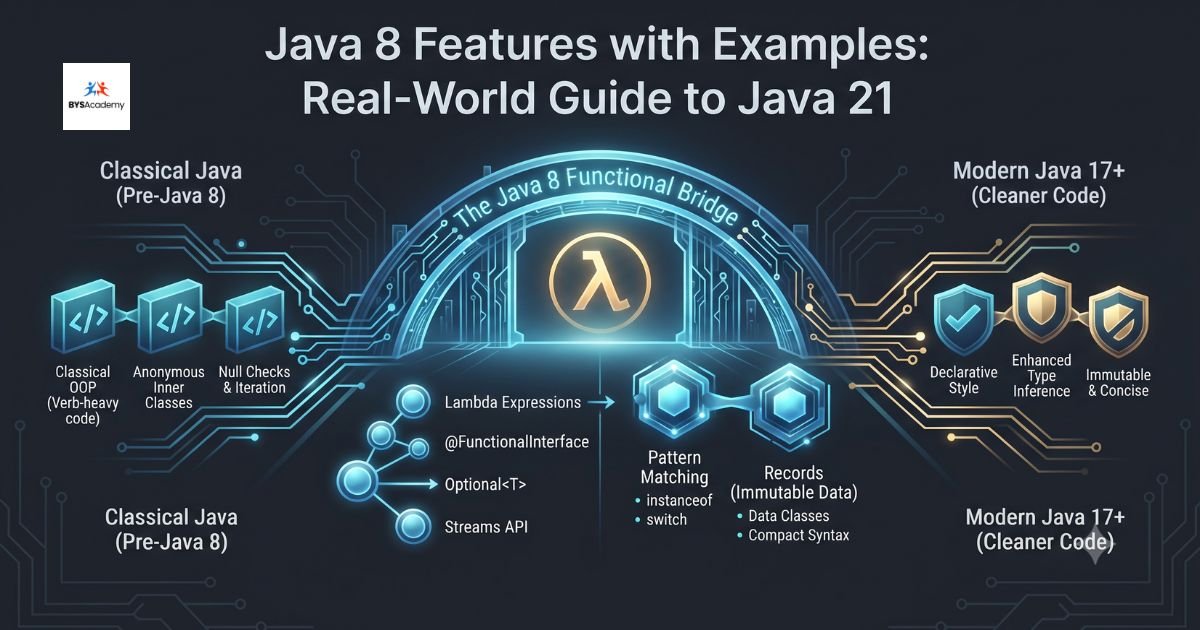
The Enterprise Migration Bridge: From Java 8 to Java 17 & 21
If your production systems are still running on Java 8, here is how these foundational features translate into modern LTS syntax:
To see the complete picture of modern JVM improvements, read our guide on 12 Key Features of Modern Java.
Summary: The Bridge from Java 8 Foundations to Enterprise Java 21
Java 8 was the watershed moment that shifted the Java ecosystem from imperative boilerplate to expressive, declarative programming. By reviewing these foundational java 8 features with examples—including Lambda expressions, Functional Interfaces, Optional, and the modern Date-Time API—you possess the exact conceptual building blocks required to write clean, concurrent, and bug-resistant applications.
However, modern enterprise engineering does not stop at Java 8. The functional idioms introduced here directly paved the way for modern Java 17 and 21 LTS innovations like Pattern Matching, Records, and Virtual Threads. Use these foundational examples as your baseline, but continuously evaluate how upgrading your runtime can unlock lower infrastructure costs and cleaner system designs.
Frequently Asked Questions
Why is Java 8 still tested in technical interviews?
Java 8 introduced functional programming, Lambdas, and Streams, which form the syntax foundation of modern Java development. Interviewers use Java 8 questions to test whether candidates understand functional patterns, memory management, and thread safety.
What is the difference between a Predicate and a Function?
A Predicate<T> always returns a boolean (boolean test(T t)) and is used for conditional checks. A Function<T, R> transforms an input of type T into an output of type R (R apply(T t)).
When should you avoid using Optional?
Avoid using Optional as method parameters, class fields, or serializable entity attributes because it adds unnecessary object wrapping overhead. Use Optional primarily as a method return type to indicate that a value may legitimately be missing.
Why is the Date and Time API in Java 8 better than java.util.Date?
Legacy java.util.Date and Calendar classes were mutable and thread-unsafe, causing race conditions in multi-threaded environments. The Java 8 java.time API (JSR-310) is immutable, thread-safe, and separates machine timestamps from human calendar dates.
Can default methods in Java 8 interfaces cause multiple inheritance issues?
Yes, the “Diamond Problem” can occur if a class implements two interfaces that provide the same default method signature. In such cases, Java forces the implementing class to explicitly override the conflicting method and resolve the ambiguity using InterfaceName.super.methodName().